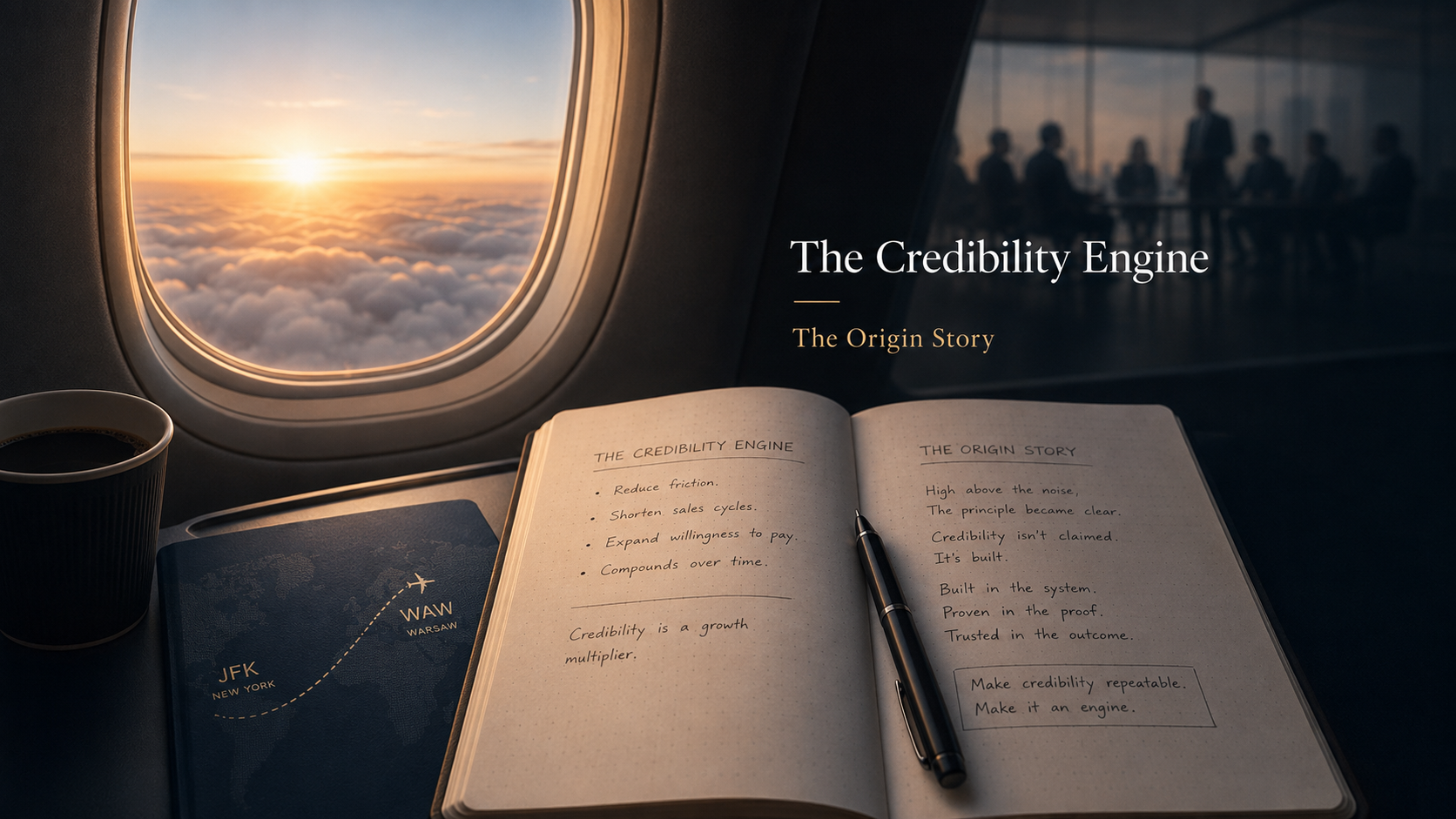
The first notes that eventually became The Credibility Engine were not written because I thought I was writing a book.
They were written because I was trying to survive a meeting.
In late 2017, we had what I refer to in the book as “the meeting that changed everything.” It was one of those moments in a company’s history where the energy shifts. The kind of meeting where people stop talking about what they hope is true and start dealing with what actually is true. By early 2018, I was on a flight to Poland to meet with the board, my manager, and the broader management team about the new plan.
Leading up to that trip, I had already started outlining what was working, what was not working, and what we needed to change. But on the flight over, with hours to think and nowhere else to go, I started taking deeper notes. I looked back at the pay-to-play events, the consultants, the outreach, the introductions, the meetings, the conversations that seemed to move, and the ones that clearly did not.
The pay-to-play event circuit and consultant ecosystem were especially frustrating because they could both create the illusion of momentum. You could spend real money, get into rooms, take meetings, and walk away with a spreadsheet full of names that looked valuable from a distance. But too often, the meetings were not high quality. They were not grounded in trust, urgency, or actual buyer intent. They were introductions for the sake of introductions, and that is a slippery slope when a company is trying to build a new market.
I was not trying to create a framework yet. I was simply trying to understand the pattern.
That pattern kept pulling me backward.
I started thinking about Criteo, where I had done business development in a fast-moving, highly competitive market. I thought about Brad’s Deals, Det-Chi Video, and even the earlier years when I was building my own businesses and trying to figure out how to get people to believe in something before the market had already validated it. Different companies. Different products. Different stages. But the same question kept showing up.
Why do some conversations move forward before the company has all the proof, while others stall even when the product is good?
That question stayed with me.
Over time, I kept taking notes. Sometimes they were serious. Sometimes I would joke with members of my operations team and say something like, “That’s going on your permanent record,” or “Ooo, this is another chapter for my book.” It was half a joke, but only half. I did not know what the book would be, or if it would ever become anything real, but I knew there was something there.
Then the pandemic hit, and like a lot of things, the idea went back on the shelf. I know some people talk about the pandemic as a period when they had time to reflect, reset, start a side project, or finally work on something creative. I saw the same TikTok and YouTube videos everyone else saw. People were baking bread, making content, building home offices, and talking about reflection time.
That was not my experience.
At the time, I was leading the U.S. business, and my focus was very simple: make sure we did not have to lay people off. That meant renegotiating contracts, protecting revenue, managing uncertainty, supporting the team, and trying to keep expansion moving while many of our clients were laying people off themselves. Most days turned into 16, 18, and sometimes 20-hour stretches, not because anyone thought that was healthy, but because the business had to survive.
We also had to think creatively about relationships. When clients were laying people off, the instinct could have been to simply protect our own interests and move on. But those were real people, many of whom were talented operators caught in an impossible market. When we could help place them into new roles, make introductions, or support them through the transition, that mattered. It was the right thing to do, but it was also another example of credibility compounding over time. How you behave when there is no immediate transaction on the table still shapes the market’s memory of you.
So no, there was no quiet creative retreat. There was just the work, the pressure, and the responsibility of getting through it. The book would have to wait.
After the post-pandemic world settled a bit, the book started to come back into my mind.
When I eventually exited RTB House, I took my first real crack at writing it. At that point, I thought maybe the book was about becoming a million-dollar seller or a million-dollar closer. I wrote somewhere around 50 or 60 pages, then hit a wall. Not a small wall. A very clear, very obvious, “this is not the book” kind of wall.
The problem was not that the material was useless. There were good stories in there and plenty of practical lessons from years of selling, building teams, launching markets, and creating commercial momentum. But the book felt too narrow. It felt like a collection of tips and tactics. It did not feel like the bigger idea I had been trying to get out of my head.
I shelved it again.
That was frustrating, but it was also necessary. I did not want to write another sales book that basically said, “Build relationships, follow up, create value, and ask good questions.” Those things matter, of course, but they were not the full story. They were not what I had seen across companies, categories, markets, and launches. It wasn’t sparking my own interest. The thing I kept coming back to was bigger than selling.
In late 2025, the idea finally started to click into place. I had been reading, listening, reflecting, and thinking about strategic selling, relationship selling, founder-led growth, market entry, and the way companies build trust before they have scale. That is when the concept of The Credibility Engine started to become clear. The original sales book was not thrown away completely. Some of those stories, tactics, and lessons still mattered, but they needed to live inside a larger framework.
The real book was not about how to close a deal. It was about how to build the conditions that make belief possible.
This idea changed everything. Once I stopped thinking about the book as a sales book, the structure opened up. I could look at the work I had done at Criteo, RTB House, PayEye, Quanthym, and other ventures through a much clearer lens. I could see the same repeatable pattern showing up across different environments. New market entry. Founder-led sales. Category creation. Strategic partnerships. Enterprise adoption. DTC growth. Even personal credibility and career development.
The more I mapped it out, the more obvious it became that credibility was not just a soft concept or a nice-to-have brand attribute. It was an operating system. It was something that could be designed, sequenced, activated, and compounded. When companies struggled, it was often not because they lacked ambition or even because the product was bad. They were simply asking the market to believe too much, too soon, without enough credible signals in place.
That became the foundation of the book.
From there, I started thinking about the stages of the journey. What does it take to move from being unknown to being considered? What proof has to exist before someone is willing to take a risk on you? How do early customers, partners, case studies, advisors, events, media, and market signals work together to reduce doubt? How do founders avoid skipping the proof-building phase and jumping straight into scale before the market is ready to trust them?
Those questions became the architecture for The Credibility Engine.
As the framework developed, the audience also became clearer. At first, I thought mostly about founders and international companies trying to launch in the U.S., because that is a world I know well. If you have traction in another market but no credibility here, the gap can be brutal. You can have customers, revenue, and a proven model somewhere else, and still feel like you are starting from zero when you enter a new market.
But the more I worked through the material, the more I realized the concept was much broader than international expansion. Strategic sellers need credibility. Entrepreneurs need credibility. Students entering the market need credibility. DTC brands need credibility. B2B companies need credibility. Anyone trying to grow, persuade, launch, hire, fundraise, partner, or build something new has to deal with the same basic challenge.
Before people buy, they have to believe.
That belief does not appear out of nowhere. It is created through signals, proof, repetition, relevance, trust, and timing. It is created when the market sees enough evidence to reduce perceived risk. It is created when the story, the product, the founder, the customers, and the proof assets start working together. That is why I kept coming back to the word engine.
Credibility is not one thing. It is a system.
The writing process itself also changed dramatically from where it started in 2018.
The earliest notes were very manual. Google Docs. Outlines. Scraps of ideas. Notes written after meetings, flights, events, and conversations. It was slow, but that was probably good. The idea needed time to mature. It needed to be tested against different companies, different roles, and different stages of my own career.
Over the last six or seven months, the process has become more dynamic. I started using AI voice tools to capture thoughts & stories while walking the dog, fixing the jet skis, exercising, working in the yard, or doing the kinds of things where ideas tend to show up when you are not forcing them. That was a big unlock. Some stories do not arrive cleanly when you are staring at a blank screen. They show up when your body is moving, and your brain has enough space to connect things.
That became an important part of the process. I could tell the stories out loud, capture the raw material, then come back and shape it into something more useful. It helped me preserve the energy of the original thought instead of losing it by waiting until I was back at a desk. In a way, the book was built through a combination of old-school note-taking, years of operating experience, and new tools that made it easier to capture the moment when the story was actually alive.
That feels appropriate for this book.
The Credibility Engine is not anti-technology, and it is not a nostalgic argument that everything used to be better. It is a book about how credibility becomes even more important in a world where content is easier to create, outreach is easier to automate, and markets are flooded with noise. When everyone can say they are credible, the people and companies who can actually prove it will stand out.
It started on a flight to Poland, during a moment of pressure, when I was trying to understand why some things were working and others were not. It lived through years of notes, jokes, false starts, pandemic chaos, failed drafts, and a lot of reflection. It became clear only after I gave up trying to write a book.
Ironically, that is what credibility really looks like.
It is the bridge between what you know you can do and what the market is willing to believe.
That bridge matters for founders. It matters for sellers. It matters for companies entering new markets. It matters for students, entrepreneurs, creators, consultants, operators, and anyone trying to build something that requires other people to take a chance on them.
That is why I wrote The Credibility Engine. Not because the world needed another book full of sales tips. It did not. I wrote it because I believe credibility is now one of the most important forms of commercial infrastructure a person or company can build, and one of the most important forms of commercial currency in the market. In a world where products, platforms, content, and outreach are easier to create than ever, credibility is what separates noise from trust. And after years of launching, selling, rebuilding, expanding, and learning the hard way, I wanted to turn that pattern into something other people could actually use.